Information in Black Hole Radiation
Abstract
In this report we discuss the fidelity and the rate at which we can retrieve the information that was thrown into a black hole. The analysis is based on the paper by Preskill and Hayden [1].
1 Introduction
The question we look into is that if Alice throws a k-qubit quantum information M into a black hole H, can Bob tell what the information was by looking at the Hawking radiation, given that Bob holds a quantum memory that is perfectly correlated with the previously emitted Black Hole radiation E. We assume the black hole dynamics to be unitary and rapidly mixing. Also, consider a reference system N which is initially maximally entangled with M. By retrieving information of M from the black hole, we mean extracting a subsystem of size which is maximally entangled with N, so that Bob can do anything with it that he would have been able to do with M before Alice threw it into the black hole.
Just after Alice throws the information into the black hole, the system B is transformed by a unitary transformation chosen uniformly with respect to a Haar measure. After some time, the black hole is in state B’ and has radiated system R which Bob observes.
Remark (Haar measure).
A complex vector in may be represented using a vector in . Unitary transformations preserve the length of this vector and hence keep it within an subspace of . Haar measure corresponds to the measure being rotationally invariant on this sphere. The expected density matrix of pure state chosen uniformly using a Haar measure is a maximally mixed state.
2 Entanglement in Black Holes
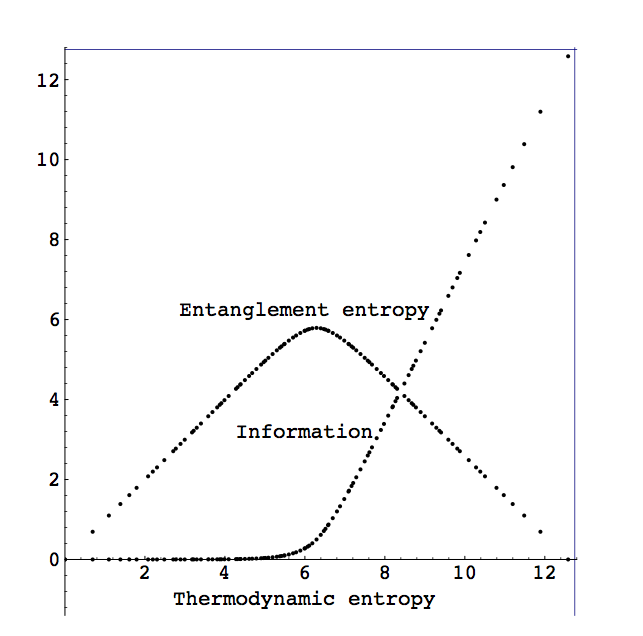
Consider first the entanglement between H and E [2]. When the black hole is just formed, and the radiation E is maximally entangled with the black hole state H. As the evaporation proceeds, declines to half it’s value and soon after . The black hole state H is then maximally entangled with radiation E.
We now give a proof of the above [3]. Consider a bipartite pure state composed of subsystems A and B. The state is chosen uniformly with respect to a Haar measure. Consider the flip operator .
We use this by creating a copy of the system .
We now compute
where U are unitary matrices. For any unitary matrix V, we have
Therefore Z commutes with every unitary matrix representation. By Schur’s lemma, Z can be decomposed as a sum of projection operators on the invariant subspaces of .
Noting that commutes with all
and hence, using ,
Therefore,
For , we have . Let be the eigenvalues of , then
Therefore, A is almost maximally mixed. Using Levy’s Lemma we can say that for almost all pure states , is close to maximally mixed.
Theorem (Levy’s Lemma).
Let be a Lipschtz continuous function on the unit sphere, i.e. . Then
The local trace distance is Lipschitz continuous.
3 Fidelity of Retrieved Information
Consider the case when so that H is maximally entangled with E. Just after Alice throws in her information, the black hole system B is maximally entangled with NE. As the information leaks from the black hole through the radiation R, the correlation between N and remaining black hole state B’ weakens, and the information in M goes to Bob. Suppose qubits have radiated in R, and qubits remain in B’.
Let be the pure density operator of BNE, and be the corresponding marginal density operator on BN. The marginal density operator on NB’ is given by
We show that this marginal density operator is very close to a maximally mixed and B’ and N are almost separable. To this end we prove the following inequality
where is the marginal density operator on N, and is the maximally mixed density operator on B’.
As was done in the previous section, and using the cyclic property of the trace
where was an auxiliary copy of the system B. and are found using the same method as in previous section
Similarly,
Therefore,
From Cauchy-Schwarz inequality,
B is maximally entangled with NE, and therefore BN is maximally mixed on a system of dimension , implying . Thus,
Hence, we see that as soon as Bob receives k qubits from the black hole radiation, he gets hold of almost all information that Alice had.
Remark (Trace distance).
The trace distance is a bound on how well can two quantum states be distinguished by a generalized measurement (POVM), and hence is a good measure of distinguishability of two states.
Even though Bob now hold’s Alice’s information in a subsystem M’ of RE, it may be very diffusely distributed within RE. Bob can then perform a computation that maps M’ to a compact localized system so that is a maximally entangled state . The fidelity, which is a measure of correlation of with , is bounded by
Thus, the state obtained after computation is very close to maximally entangled. To prove the above inequality, we start with the definition of fidelity
Now consider the basis that diagonalizes with eigenvalues and U the unitary transformation .
where in the last line we have used the property that and are positive semi-definite Hermitian operators. Therefore,
is the purification of NB’ density operator . If N and B’ are decoupled, then ER can be split into two subsystems such that purifies and purifies
By Uhlmann’s Theorem, where max is over all purifications of . As is the purification of , there exists a purification of the state , such that
As a corollary to Uhlmann’s theorem, we have because purifications of AB are also purifications of A. Hence, performing a partial trace on the subsystem in the above inequality, we obtain
Remark (Fidelity).
An equivalent definition of fidelity is , where the set constitutes a POVM. If the given state is , outcome i will have probability , and if the given state is , outcome i will have probability . The fidelity is thus the correlation of the two probability distributions.
For the case when , essentially no information is released until the black hole has radiated enough so that equals , because till this time the radiation is maximally entangled with the black hole and N may be coupled to B’. But soon after this state is reached, the above analysis becomes applicable and black hole starts radiating the information that Alice had.
4 Conclusion
We observe that if the black hole has radiated more than half of it’s initial state, any k qubit information that is thrown into the black hole gets reflected back in the next k qubits the black hole emits, assuming the black hole mixing happens rapidly. In case the black hole is new and hasn’t radiated enough, it emits the information in the next k qubits past it’s half evaporation.
References
- [1] Preskill J., Hayden P. (2007). Black holes as mirrors: quantum information in random subsystems. arXiv:0708.4025v2.
- [2] Page, D. N. (1993). Information in black hole radiation. arXiv:hep-th/9306083v2.
- [3] Lubkin, E. (1978). Entropy of an n-system from its correlation with a k-reservoir. Journal of Mathematical Physics, 19, 1028.